Dog Acupuncture 05/14/2010
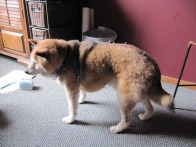
![]() This is Toby. He's coming to see me for arthritis. He's 16 years old - he looks GREAT for his age, right? People ask me, all the time, HOW I do acupuncture on pets. Don't they move around? Do they bite you? Do you have to anesthetize them? Nope! Just look at Toby! He hardly even notices that the needles are in! Some dogs will lay down and fall asleep. Some do move around (and this is fine!). My main goal (aside from making them feel better via acupuncture and herbs, of course) is to make sure that they're comfortable and unstressed when they come visit me. A stressed animal is preventing the acupuncture from working to its full potential, so keeping a relaxed environment is KEY to speedy healing. Stay tuned for video of my buddy Benny who's being treated for post-surgical pain in his knee, and you'll see just how relaxed most dogs are during their treatments! Why do I have to go to acupuncture so often? 09/24/2009
![]() This is a question that I get asked regularly. We're used to seeing our doctors only in times of trouble (even if then!) and otherwise, we go on our own merry ways. So when an acupuncturist says that they'd like to see us again in a week, we question it. In our society, because we don't go to the doctor until we're experiencing symptoms that are bringing us to our knees, we've dug ourselves into a bit of a "health hole." What do I mean by that? We spend our lives worrying, and stressing, and not exercising or eating properly, in effect neglecting our bodies, until our bodies finally break down and we experience a symptom that is worth complaining about. But in Chinese medicine, we've been unhealthy and out of balance for a lot longer than this uncomfortable symptom has existed! In order to get back to a truly healthy state of being, one in which our uncomfortable symptoms don't come back a short while after treatment, it takes time - and practice. Our bodies have forgotten, and need to relearn, how to be healthy! When we get acupuncture, it does its thing for a certain amount of time. Some people may feel better for a whole week after their first couple of treatments, while some may only feel better for a couple hours. How long an acupuncture treatment lasts depends on the person, how out of balance they are and how quickly their body responds. It is best to get another treatment before much of the effects of the acupuncture have worn off. For some people this will be a couple times a week, but for most people this is once a week. Now remember, the whole point here is that your body starts remembering how to be healthy on its own - without ANY outside help. So once you become symptom-free from treatment to treatment, your acupuncturist will start spacing out your treatments. If you were coming in once a week, perhaps you'll go to every other week for a while, then maybe once a month. In effect acupuncture is reminding your body how to be healthy again, and once it starts remembering, it's time to wean you off treatments so that your body has the opportunity to practice being healthy between visits! Just like riding our first bikes, once we get the hang of it, and our bodies know how to be healthy again, it's time to take off the training wheels! What is Reflexology? 07/27/2009
![]() Reflexology is believed to have been used in China, India and Egypt as long ago as 5000 years. It was brought to the US by Dr. William Fitzgerald during the 1920s, and has continued to flourish as a treatment option to this day. Reflexology theory holds that your entire body is mapped out onto your feet. When certain points are massaged, corresponding areas of your body will be effected. All treatments involve a Chinese Medical diagnosis so that appropriate areas can be massaged for each individual patient. Much like other forms of Chinese medicine, Reflexology is a system that treats the body as a whole, not just the symptoms of a biomedical complaint. Reflexology has been shown to be an effective treatment for digestive disorders, headaches, various body pains and more! If you receive a reflexology treatment, always make sure to drink plenty of water following treatment as uric acid that has settled into your feet due to gravity will be released during your treatment! Much like after a massage, if these chemicals are not diluted by water you consume, you may experience feelings of nausea or muscle aches. What is Qi? 07/03/2009
![]() Ooooh, this is a fun question! Biomedicine has been wondering this FOREVER! (Or, at least since they learned of Chinese Medicine and Qi.) I like to tell my patients when they ask, that Qi is what makes the difference between being alive and being dead. Biomedicine doesn't know what makes us alive vs. dead, and they don't know what Qi is. Coincidence? I think not! One textbook definition of Qi is "The fundamental substance of which all matter in the natural world are composed. All matters in the natural world are formed by the change and movement of Qi." (Advanced Textbook on Traditional Chinese Medicine and Pharmacology, Vol. 1. New World Press, Beijing, China, 2002.) Another textbook similarly describes it as "The fundamental substance constituting the universe, and all phenomena are produced by the changes and movement of Qi. Qi is both the essential substances of the human body which maintain its vital activities, and the functional activities of the organs and tissues." (Chinese Acupuncture and Moxibustion. Foreign Languages Press, Beijing, China, 2003.) Free, smooth movement of sufficient amounts of Qi is essential to health and vitality. When this is not the case, we begin to experience unhealth. Acupuncture is certainly not the only way to achieve free and plentiful Qi. Health CAN be retained and regained through healthful living, but Chinese medicine can speed the process back to health. In addition, Chinese medicine can PREVENT disease by ensuring that the amount of Qi that one has is always in adequate supply and moving properly throughout the body. So what does Qi feel like? To me, as a practitioner, when I needle a patient and I'm aiming for the Qi, it often will feel like the tip of my needle is bouncing on the surface of a balloon. When I "get the Qi" it feels as though this balloon has let the needle in. I've heard other practitioners describe it as a gentle tugging sensation on the tip of the needle. My patients often say that Qi feels like someone pressing on their skin at the site of the needle. Some patients will feel this same sensation of pressure run along the channel after the needle has been inserted. Some people will feel the Qi as a mild warm or cool sensation at the needle. Perhaps it's this inability to even describe the sensation of Qi that has led so many to be skeptical of its existence? Okay, maybe it's due to the fact that there are no biomedical tests that can prove that it exists. Regardless, Chinese medical practitioners can feel the Qi in your pulse, can see it reflected on your tongue and in your face, and can feel it through the needles. Thousands of years of patients and practitioners and positive results can't ALL be wrong. This is your new blog post. Click here and start typing, or drag in elements from the top bar. Tricks for getting those herbs down 06/02/2009
![]() If you're getting acupuncture done, chances are you're taking some form of herbs. They're not always pleasant tasting. They've been described as tasting, depending on the particular formula:
If you're taking a bulk formula (one where you're given the raw herbs and you make your own "witch's brew"), try making it a little more concentrated so that you don't have as much liquid to drink in the end. Once you have this smaller amount of liquid, try mixing it with your favorite juice. Many of my patients have found cranberry juice to be the must disguising of them all. Experiment and see what works for you and with your particular formula. If you're taking a granule formula, you have several more options:
Remember, you've paid for these herbs, you've invested not only your money, but time and your future into becoming healthier. Make sure to take your herbs as prescribed, and you're on your way to THRIVING! Do you have any other tricks for taking herbs? I'm always looking for more ways to help my patients take their herbs! How long does it take this stuff to work? 04/08/2009
![]() So, you've had your first acupuncture treatment and now you're wondering, "Okay, so when am I going to feel blissfully different, like everyone talks about?" The short answer? It depends. I know, you probably don't really like that answer. But don't worry, I'll give the long answer next. We're all different. This is the basis for Chinese medicine. We're all different, so we all get different treatments. We all heal at different speeds. Also, the speed to which we heal can depend on how long we've been experiencing our unhealth. A sore back that was caused by working too hard in the garden last weekend will heal much faster than a back that was injured 20 years ago on the job and flares up periodically. Now, this isn't to say that a chronically injured back can't heal quickly. That all depends upon:
If you're wondering how long it may take for you to get healthy again, please talk with your acupuncturist. They may be able to give you a ball-park idea of how long it may take. After a couple of treatments, your acupuncturist can usually give you a better idea of how long it will take based on the early changes you experience. Pulse diagnosis in Chinese medicine 04/07/2009
![]() Chinese medicine is a medicine that evolved somewhere between 3000 and 5000 years ago (at least that's the best guess, some think it may be even older!). This was all before the time of MRI's, x-rays and blood tests. In order to get an accurate diagnosis, the Chinese medical practitioners of ancient times looked very carefully at the body to gather as many clues as possible. One of the methods of looking at the body closely evolved into pulse diagnosis. Now, we've all sat at the doctor's office and had them count the number of times our heart beats per minute. They commonly take this reading at wrist on the radial artery. Chinese medicine took this a step further. Not only does an acupuncturist or herbalist count the number of beats per minute, they also can get an overview of what's going on in your body by feeling the quality of your pulse. Each wrist has three pulse positions. On the right wrist, the energy of the Lung, Large Intestine, Spleen, Stomach and Kidney Yang can be felt. On the left wrist, the energy of the Heart, Small Intestine, Liver, Gall Bladder and Kidney Yin can be felt. Each organ can be assessed by feeling the qualities of the pulse at its position on the wrist. The qualities or textures of the pulses that can be felt at each position on the wrist are:
Tongue diagnosis in Chinese medicine 04/06/2009
![]() If you've been to an acupuncturist, you've heard the line "Okay, now I'd like to take a look at your tongue." If not, you may be wondering what the HECK an acupuncturist would want to see your tongue for? Our tongues mirror the health of our bodies, and by looking at your tongue, an acupuncturist can get helpful clues as to what's going on inside you. When your acupuncturist is looking at your tongue, they're looking at several things: 1. General shape of your tongue: Is your tongue a nice "U" shape? Does it have a thin pointy tip? Does it look like your tongue is scalloped or that you've taken bites out of the edges of your tongue? If your tongue is a "U" shape, this is a pretty good sign of overall health. If you've got a pointy tip to your tongue, you probably have some sort of yin deficiency. If your tongue is scalloped, you probably have problems with dampness and Spleen Qi deficiency. 2. Color of your tongue: Is your tongue a baby pink color? Is it beet red? Is it purple? Or maybe it has pale sides? If your tongue is a baby pink color, you probably are pretty healthy with few complaints. If your tongue is red or beet red, you probably suffer from some sort of heat problems. Hot flashes often present with a bright red tongue. If your tongue is purple you're likely in some sort of pain or are very stressed out (or both!) 3. The coating of your tongue: Can you easily see the color of your tongue? Is it hidden by a thick, greasy-looking substance that you try to brush off with your toothbrush every morning? If you can easily see the color of your tongue, you probably don't have any dampness problems. However, if our tongue coating is thick and it masks the color of your tongue body, you likely do suffer from such complaints. I'm not going to put pictures of tongues on here, because not everyone has the stomach for it. If you do have the stomach for it, ask your friends and family if you can see their tongues. You'll be surprised at how different tongues can be from one another! Chinese herbal formulas 101 03/30/2009
Welcome class, take a seat and get comfortable! Today, we're going to talk about Chinese herbal formulas. There are three forms of herbs that you can take, each has its benefits and drawbacks. ![]() Let's start with the simplest: Tea pills. Teapills are little pills (about the size of BBs) that are pre-made in standard formulas. Because the herbs are already mixed and put together into these pills, there is no room for customizing the formula EXACTLY for each patient. Don't worry, though. Tea pills are often a pretty darn good match for many people, and most people won't experience any side effects from them. The best thing about tea pills is their convenience. You can take them with you, they're not messy and there's no preparation. There have been problems with tea pill formulas coming from China that include pharmaceuticals or heavy metals so make sure that the formula you are given is made in a Good Manufacturing Processes (GMP) Certified factory. ![]() The next step is the granular formula. Granules are a substrate (a grain of some sort) that has been ground finely and had a Chinese herb decoction sprayed onto it. These granules can be single herbs or whole formulas. Because you can mix and match granules, you can customize the formula to each patient allowing for an exact match and no side effects. Granules are either dissolved in water and then swallowed, or some people prefer to place them on their tongue and "chase" the formula with water or their favorite juice. Granules are pretty convenient. You can bring them with you so that you can take them at the prescribed times. Granule formulas tend to have an "earthy" taste to them, with the exact flavor depending, of course, on the particular herbs used in the formula. A caution for those with food sensitivities: the substrate may be an allergenic grain (corn, wheat, rye, barley) so be sure to ask your practitioner if this is a concern. ![]() The final type of herbal formula is a decoction. A decoction is kind of like a tea that's made by boiling the actual dried herbs yourself at home. When I cook my herbs, I often find myself saying "Double, double toil, and trouble..." (and cackling. But hey, I'm an herb nerd!) However, you won't find eye of newt or toe of frog here - you'll usually find sticks, twigs, leaves, flowers, seeds, roots and berries. The ingredients are boiled for usually around 30 minutes, the herbs are scooped out and the liquid is what is consumed. Herbal decoctions are by far the strongest preparation of Chinese herbs, but they can take some time since you'll need to boil up a new batch of herbs everyday for the duration of the treatment. If you're vegetarian or vegan, and would prefer to not have animal products used in your formula, make sure to inform your practitioner, because there are occasionally animal products used in extreme cases. No matter the type of Chinese herbal formula, make sure to talk with your practitioner about what will work the best for you. Remember, if you don't take your herbal formula because you didn't have the time to make it, that's not only money wasted, but health wasted! Cupping 03/06/2009
![]() Cupping is probably the most recognized of the lesser-known Chinese medical techniques. If you watched swimming during the Olympics, you may have seen Chinese swimmer, Wang Qun, with her Cupping marks. Your acupuncturist will light a cotton ball that has been soaked in rubbing alcohol on fire. Using a hemostat to hold the lit cotton ball, they will hold it in the cup for a moment, remove the cotton ball, then quickly place the cup onto your skin. The burning cotton ball burns the oxygen out of the cup which will create a vacuum when placed on the skin. Like Gua Sha, Cupping is used to pull toxins through the skin out of the body. And like Plum Blossom, Cupping helps to release pathogens that are trapped within the body. This is a great technique for muscle tension and soreness, as well as colds, flu and skin rashes. Because of the suction that is created, there is the possibility of bruising. These bruises are not painful. As with Gua Sha, please talk to your acupuncturist about whether the time is right to have Cupping done (be prepared for questions if you're going swimming or wearing a backless dress!) |


RSS Feed